We Listened: Public perception of forestry is harming mental health
Public perceptions of forestry can affect those working in the sector; but better communication could help bridge the gap between people and the work that keeps our woodlands healthy.
Public perception is harming the mental health of foresters
The Breaking Points survey in 2025 was clear that the way foresters are treated whilst trying to do their jobs is a key factor in how they are struggling to cope. Survey respondents reported hostility, aggression, and a lack of understanding. Aggressive behaviour and hostility towards those who cut down trees and control deer and squirrel populations is sadly already commonplace. Forestry work is often misrepresented and negatively portrayed in the media it normalizes and justified this damaging behaviour towards workers. We heard stories that included feeling ostracised, receiving hateful messages through social media, and being misunderstood regarding work that they really care about.
The statistics of how this impacts mental health were dire; 44% of survey respondents shared explicit mental health struggles, with 35% mentioning chronic burnout or emotional exhaustion. 18% made direct references to grief, trauma, or PTSD linked to accidents and fatalities at work. The effect is deadly.
A communications problem
David Attenborough said “Saving our planet is now a communications problem. We know what to do, we just need the will.” The same could be said for the mental health of those currently working hard in areas that we are relying on in the face of climate change. Healthy trees need healthy people, and those people are being impacted every day.
When public perception is influenced by mis- and disinformation forestry is lumped in with deforestation, when cutting down a tree brings comparisons to The Lorax, when attempts to control pests such as squirrels and deer that harm trees is considered the same as putting down a favourite pet, there is a distinct communications problem.
We listened to the distress from the sector, and knew that tools within communications had to be part of the picture. Small businesses, those working long hours to scrape by, are not those with a marketing team and social media influencers pulling on heart strings with detailed campaigns. Part of the solution had to include assistance in helping their voices be heard, reach the right people, and manage the negativity within social media, ideally making it as easy as possible.
The foresters can have perfectly valid reasons
We know that foresters, woodland managers, arborists, etc, overwhelmingly go into this sector for the love of the environment they work in. Accusations of harm against nature being purely for profit do not work alongside a sector of hard work, long hours, and unstable wages. These are not the people who dreamed of an easy life on a billionaire fortune.
Instead, forestry works consists of long-term thinking of what is best for the habitats, the timber, and the resilience against potential future threats. It requires careful management of complex requirements, various difficulties, as well as public safety. The timber industry would have collapsed if clear cutting was considered a quick fix. It never makes financial sense to cut everything down and sell it off – trees take decades to grow, and replanting is hard work and carefully considered. The timber we produce in the UK avoids imports that bring biosecurity issues and threaten native species. It is also a better sustainable building alternative that holds in carbon far better than steel or concrete ever could.
The public can be well-intentioned
In many ways the shock and anger felt by the public when they see trees or plots cut down is a positive indication of their appreciation of the trees and landscapes that exist. There is clearly an intrinsic attachment humans have to the natural world: it has been proven to lower stress and keep us healthier. As foresters it is important that people value the natural environment, learn more about trees and be more involved in their care. But on the odd occasion that anger is aimed at those doing the work, and without the full understanding, it can be extremely harmful.
Social media throws oil on the fire
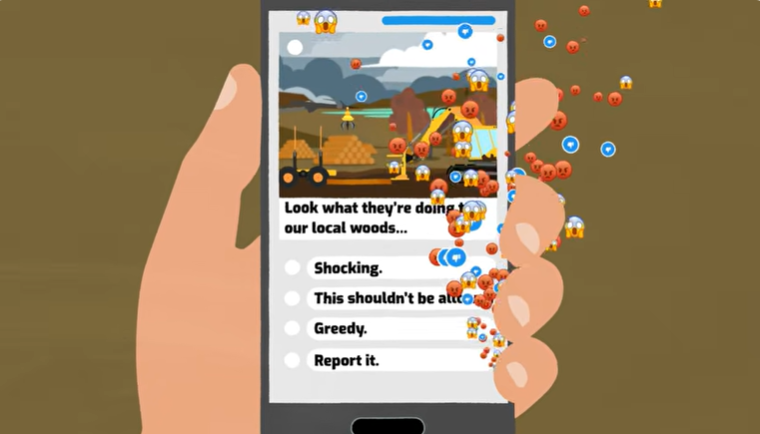
Social media can be toxic. The algorithms that control what you see are built on a model that wants you to engage, wants you to share, and stay on the platform as long as possible because their revenue stream is advertising. The more eyes on their content, the more money they make. Unfortunately tech learnt a long time ago that the biggest pull is ragebait – the content that pulls at your chest and makes you want to correct someone, voice your opinion in defence, or pull you into the vocal minority that attacks loudly. Most social media platforms will boost the amount they show a post if someone reacts angrily to it (and some creators use this to their advantage), if you comment on a post and that gets a reaction from someone else, sparks an argument which continues over days, more and more people will be shown that, and the negativity spreads like a virus. Positive posts just aren’t as profitable (maybe with the exception of dog and cat videos which we don’t seem to be able to resist).
The reality
This was the experience of foresters and arborists that we heard repeatedly. One post about a project cutting down a section of trees could spiral into days of abuse, news organisations jumping on a story about how the community was outraged but without the context to quell it, and the workers themselves struggling to cope with the onslaught. It damages trust and respect for skilled workers, and spreads mis- and disinformation, which only harms the environments in the long term as fewer people bear the burden.
The solutions:
1. Communications tools for foresters
Sometimes the simple things can really help – signs, email templates, advice for social media, to help an organization build trust and positive interaction with the community they are working in. Pre-empting the questions that communities might have about works really helps cut through that initial shock when done well. It can also help educate and involve members of the public in ways that will help trees stay healthy for generations to come.
2. Information for the public
Although more difficult, it is not impossible to inform the public *before* the outrage occurs, supplying the information, and boosting understanding of woodland management. Public perception is not fixed and the more we can impact the “common sense” portrayed in media and schools, the more we can avoid misunderstandings that harm those working in the forestry sector. This can include simple lessons on what trees need, how to spot problems quickly to avoid bigger issues that may require the destruction of entire woodlands. The more citizen scientists involved, the better for the long term health of trees and woodlands.
We have much further to go
We listened to the experience and considered the problem. The two animations were created to help reach the public and start conversations about the mental health of forestry sector workers, the first about the harm done to the individuals, and the second about how the public reactions can misunderstand forestry work. So far they seem to have been received well but there is much further to go.
“I think this message is becoming increasingly important as more people seem to be disconnected from the realities of the natural environment around them, and from the wider consequences that their choices can have on both the environment and the people who work within it.” – Josh
“We all need to do much more in explaining the need for home grown commercial timber, the management of multipurpose woodlands and the huge benefits to society that those working in this industry deliver, addressing some of the nation’s most pressing challenges.” – John
“I have just put my tin hat on and posted this animation on my local town Facebook page. I am genuinely apprehensive because I’m not sure what the response will be… But if the RFS are giving us such an amazing tool to get the message out there, we should use it.” – Ros