Hidden History: The Lumberjills’ Legacy (Show Notes)
On Gone Foresting: An RFS Podcast Elle was joined by Joanna Foat to discuss the history of women in forestry and the hidden history of the Lumberjills.
Women in Forestry Pre-WWII
Women in forestry is nothing new, and yet it is rarely mentioned in history. We can make assumptions given what we know about society but for much of history a woman working in woodlands alongside her family, gathering firewood or planting new saplings, is unlikely to have been remembered for her work. In part rural history tends to be less documented, and in part women were offered less education and opportunities, and weren’t necessarily credited for skills they had.
However, there are some key figures who had started to break the mould that lay the groundwork for the Lumberjills and other women in forestry today.
Mary Sutherland
In 1915 she became the first woman in the world to finish university with a BSc Forestry from University College of North Wales, Bangor. After moving to New Zealand she overcame opposition to become a legendary forester, founding member of the New Zealand Institute of Foresters in 1927, and vice-president in 1940.
Rosamund Crowdy
Started the Women’s Forestry Service in 1917 as part of the Land Army in the First World War. Starting with employing just 45 women, by the end of the war the WFS had employed 2000 women with another 1000 unofficially in local forests and sawmills.
Marie Beatrice Schol-Schwarz
This Dutch phytopathologist discovered Dutch elm disease in 1922 helping future generations understand the fungus.
The societal pressures and attitudes about appropriate gender roles were large barriers for women wanting to stretch into physically demanding roles. Yet, E. P. Stebbings wrote: “The life of a Forester is pre-eminently an open-air one…. It renders the possession of a good physique, good health and active habits indispensable. Girls, the modern girl at any rate, may be considered to possess these attributes to much the same extent as young men”. It might have been a more progressive attitude than most in 1916 but the Women’s Forestry Service proved him right just a year later.
After WWI had ended, women were largely forced to give up their employment as men returned, and traditional gender roles remained.
Britain began to forget that women were ever involved in forestry.
Joanna has given a voice to the Lumberjills. As many of them reach the end of their lives, she has captured their personal experiences in their own words ensuring that their stories endure for future generations.
Behind the Lumberjills
Twenty years before Britain had fought in the First World War, but the timber supply had not been replenished quickly enough to be prepared for the next. Britain had imported more wood than anywhere else in the world and only produced 4% of timber it used. With imports becoming more dangerous and Europe on the eve of war, with limited stockpiles, Britain was in trouble.
The assumption was that forestry was not women’s work, but in 1940 the Forestry Commission first surveyed women already working in forestry, and perhaps reluctantly agreed that it was an option.
When eventually, with some pressure from fierce women such as Lady Gertrude Denman, the Women’s Forestry Corps was approved, around 18,000 women between 17 – 24 years old signed up. They worked hard, battled discrimination, and the prejudices of local communities at the end of the day.
However, they also influenced great change. The freedoms that women experienced allowed them to dream bigger, and not everyone was willing to let go of that once the war was over. Lumberjills (and those in Land Army) triggered changes in society, including fashion, and expectations of women forever.
Tell Me More
Joanna Foat went to meet over 60 women to hear their stories of time in the Lumberjills, and more women (or their families) contacted her and continue to do so to share their stories. We only scratched the surface in the podcast, and there are many more stories in her history book.
Instigated by the first woman to chair the Forestry Commission, Forestry England also went on to tell The Lumberjill’s Story and compiling The People’s Picture, sharing photographs and fact sheets about the Lumberjills. You can find a selection of those below:
WWII came to an end, and the Women’s Timber Corps was disbanded in 1946. The men who returned reclaimed their jobs, and options for women wanting to continue work in the forester sector was bleak. However much the Lumberjills had proved themselves and had gained praise, much of society were keen to return to “normal”.
Until 2000 those who served were not allowed to join the march past of the Cenotaph on Remembrance Sunday. And it wasn’t until 2007 the government acknowledged them and a memorial was unveiled in Scotland honouring their war effort.
A lot has changed since then, not least the number of women entering and succeeding in forestry. By 2023 45% of Forestry England’s workforce are female, and we’re thankful that the sector continued to honour women’s achievements.
I have to admit that a mere man will have to take care if he is to be recognised as a forester in future. The women in charge could lay a tree with the best of men and it is some considerable time since I saw anyone so knacky [proficient] in the handling of an axe.
Further Resources
- Five Inspiring Women Who Shaped Forestry (Forestry Journal)
- Women in Wartime (University of Manchester)
- ‘The Forgotten Army of the Woods’:
The Women’s Timber Corps
during the Second World War – Emma Vickers (British Agricultural History Society) - Women in World War One: Women’s War Work & The Women’s Forestry Corps (Tales from the Archives)
- Museum of English Rural Life (a great resource for rediscovering diverse voices in rural communities)
Events
Share a Story.
Celebrate Women in Forestry.
Have you been inspired by a woman in forestry?
She might be a colleague, mentor, friend, family member, or a figure from the past—someone who taught you vital lessons, supported your journey, or is simply exceptional at what she does. We want to hear about her.
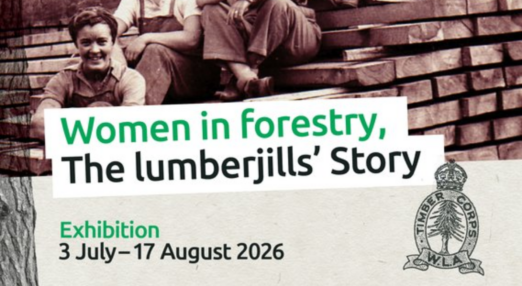
Women have long played a crucial role in forestry, often without recognition. From the Women’s Timber Corps known as the “Lumberjills” who worked tirelessly during the Second World War, to the women shaping the sector today, these stories deserve to be remembered and shared.
Take part:
Download and print the form below to submit your story and return to RFS HQ
or
Email your contribution to Elle McAllister
Any photographs would be happily received and credited appropriately but please ensure you have permission for RFS to publish them online before sharing them.
Why it matters
Your contribution will become part of an RFS digital archive of women in forestry history—helping to honour those who came before us, preserve rural and women’s stories, and inspire future generations to follow in their footsteps.
Every story matters. Help us ensure these voices are not lost
Thank you to Joanna Foat for taking part in this episode and advocating for the Lumberjills.
Thank you to Susan Pynegar for supporting the production of this Women in Forestry podcast.