From hands-on forestry to Certified Forester
"I feel proud every time I tell a client I am an RFS-Certified Forester." Forester, Tom Sullivan talks about the impact that RFS Certification has had on his career.
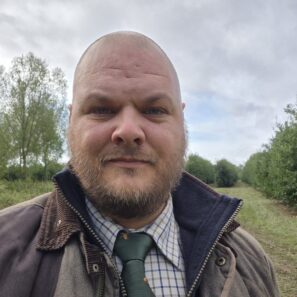
Tom Sullivan
RFS Certified Forester
I have been working in the forestry sector since 2008, undertaking a range of roles over the years. My mainstay has always been hand-felling hardwoods and planting across Herefordshire and the surrounding counties — landscapes defined by beautiful lowland broadleaf woodland and a rich forestry heritage.
Like many people who begin their careers in forestry, I started on the ground — saw in hand, out in all weathers. Those early years gave me a deep respect for the physical and biological complexities of woodland management.
After several years working independently, I was fortunate to join Forestry England as a Forest Craftsperson, a role I held for four years. During that time, I helped manage and maintain woodlands across the Marches. This experience broadened my understanding of the operational and managerial sides of forestry — from planning and health and safety, thinning, regeneration and also public interaction. It also reinforced the importance of teamwork, communication, and careful planning in ensuring the long-term health and resilience of our woodlands.
More recently, I ran a planting and maintenance business with my wife, Natalie. Together, with a team, we worked on many of the major estates within Herefordshire and the neighbouring counties. Planting thousands of trees each season teaches you patience, precision, and an understanding that every decision — from species selection to spacing — shapes the future of that woodland for generations.
We took immense pride in our work, knowing that what we planted today would hopefully stand for future generations. There is a quiet satisfaction in returning to a site years later and seeing young trees thriving where there was once only bare ground — knowing that your efforts have helped shape a future landscape.
In May of this year, Tom Blythe of Chalford Silviculture Ltd, a manager I had previously undertaken a lot of work for, approached me with the opportunity to join him as a Forester, helping to manage the estates within the company’s portfolio. I will admit, I hesitated at first. Traditionally, the title of “forester” has often been associated with those who hold academic qualifications — a degree in forestry or land management, for example. My background has always been rooted in the practical, hands-on side of the industry.
However, Tom recognised the value of my experience. He understood that forestry benefits from a blend of theory and practice — that those who have spent years planting, cutting, and managing trees bring a perspective that complements academic training. His encouragement gave me the confidence to step into the role and represent the practical side of forestry at a professional level.
When I took on this position, I also wanted to demonstrate to clients and colleagues that my commitment to the profession runs deep. I’ve long admired the Royal Forestry Society (RFS) and its values — its focus on education, sustainable woodland management, and recognition of practical excellence. I contacted the RFS to see whether I could become a member and potentially achieve Certified Forester status.
The response was immediate and welcoming. The application process involved reflecting on my career, my experience, and my approach to woodland management — which was a rewarding exercise in itself. I later attended an interview, and I am proud to say I was successful. Becoming an RFS Certified Forester has given me a huge sense of pride and validation.
For me, the certification represents more than just a title. It is an acknowledgement that practical forestry experience — the kind earned through years of physical work, problem solving, and hands-on learning — is just as valuable as academic training. It has also given me renewed confidence when working with clients, knowing that my skills and experience are formally recognised by one of the most respected institutions in British forestry.
Since joining Chalford Silviculture, I have continued to expand my skills — particularly in planning, restocking, and woodland creation projects. I am involved in everything from assessing deer impact and developing restock plans to liaising with contractors and ensuring that operations are carried out to high standards.
The diversity of the work keeps things interesting and constantly reminds me that forestry is as much about people as it is about trees — about working collaboratively, communicating effectively, and ensuring the best possible outcomes for the landscape. Looking ahead, I am keen to continue developing both professionally and personally within the sector. There is so much happening in forestry right now — from climate resilience and species diversification to the growing emphasis on natural capital and sustainable management. It is an exciting time to be part of it.
To anyone reading this who has spent years working practically in forestry but perhaps doesn’t hold a formal degree, I would strongly encourage you to look into the RFS Certified Forester programme. It is a fantastic way to gain recognition for the skills and dedication that come from real-world experience. Forestry is a broad church — and it needs both those with academic expertise and those with boots-on-the-ground knowledge.
I feel proud every time I tell a client or colleague that I am an RFS Certified Forester. It is more than a credential; it is a reflection of a lifetime’s work and a reminder that dedication, craftsmanship, and a deep love of trees can be just as valid a pathway into professional forestry as any degree.
Read more: