“The best time to plant a tree was 20 years ago, the next best time is now!”
To mark National Tree Week, we invited Avon Needs Trees, winner of the 2025 Excellence in Forestry Award for Community Woodland of the Year, to share their people-focused approach to tree planting and woodland management.
National Tree Week is all about getting people engaged in trees and woodlands. Few have done this better than Avon Needs Trees, a charity that won Gold at the Royal Forestry Society’s 2025 Excellence in Forestry Awards for Community Woodland of the Year, sponsored by the Woodland Trust. The 46-hectare woodland creation project seeks to tackle the climate crisis, address flood risk in the Chew Valley and provide a space for the community. Amy Timms, Land and Habitat Officer, tells us about her entry to the sector and explains how Avon Needs Trees creates woodlands that support people and planet.
How did you get involved with community woodlands?
My career change into forestry truly began at Great Avon Wood.
Like many people, I was feeling somewhat aimless and overwhelmed by the climate crisis and biodiversity loss in the UK. I originally came from an arts background and knew that I wanted to retrain to work in the green sector, but was unsure of which area or how to get started.
I studied horticulture through the RHS, which gave me good foundational knowledge in plant growth and development. I soon realised that my main interest is in the cultivation of trees and shrubs. This steered me towards forestry and getting some practical experience under my belt. I asked a friend who runs a food forest project if he knew of anywhere I could get some woodland creation experience and he suggested Avon Needs Trees (ANT).
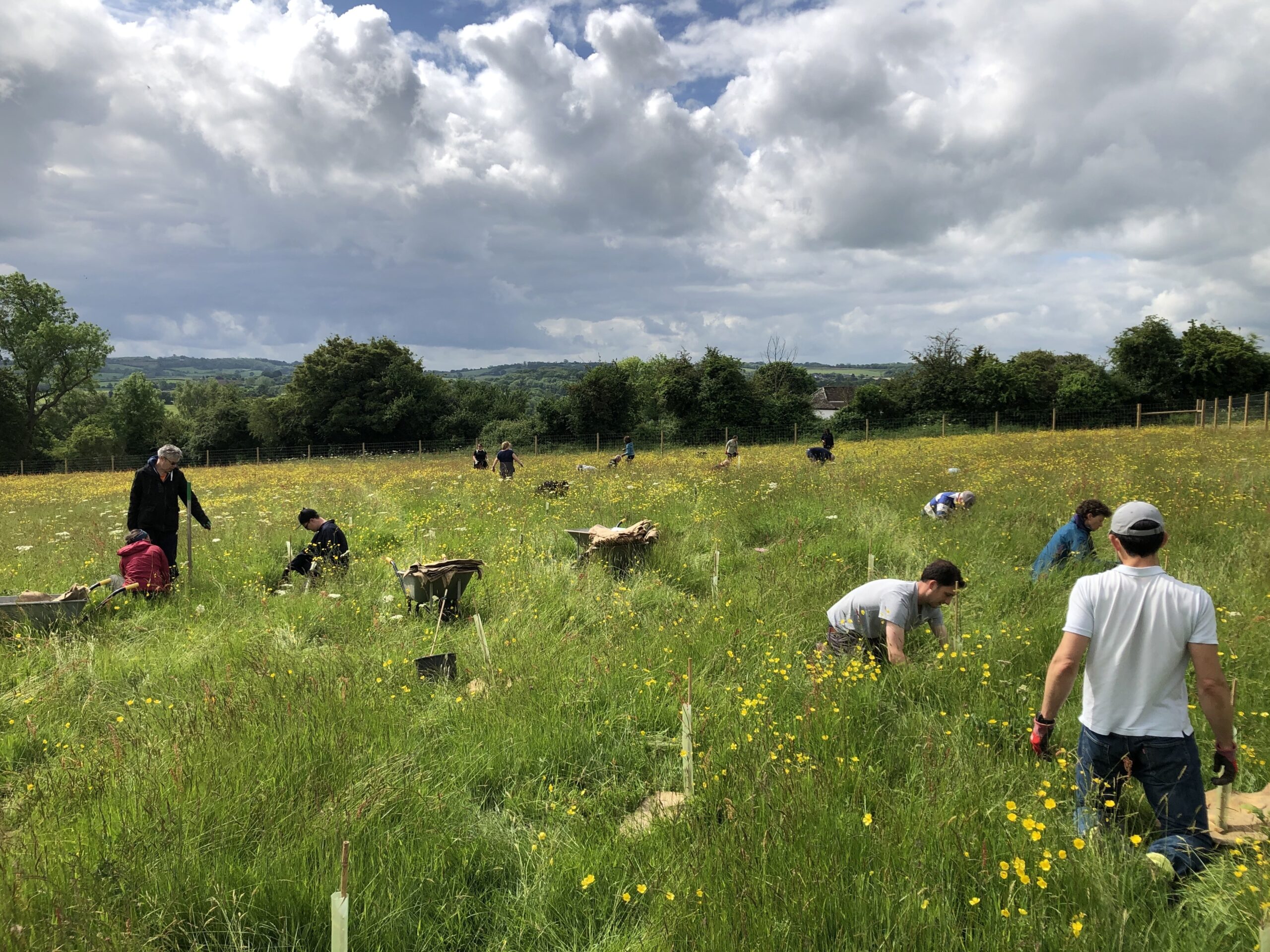
On a gloriously sunny morning in May 2023, I took the bus from Bristol to Pensford and rocked up to a field swathed in meadow buttercups, to help on a volunteer day. From my casual conversations with the staff leading on the day, I quickly realised that this was the right fit for me and I became instantly hooked! I began volunteering as often as I could; eventually progressing to become a volunteer leader, and a student of Avon Needs Trees’ free six-month Woodland Skills course (which really helped to focus my interests and expand my skill set), to eventually becoming a member of staff.
My role as a Land and Habitat Officer is principally ‘boots on the ground’. Because of this, I get to see the subtle changes across our sites. I’ve witnessed which species are thriving and which need a bit of help. Lots of interesting flora and fauna pop up; it’s quite common when doing maintenance to discover some little critter has made its home under a mulch mat or within a tree tube.
Avon Needs Trees works closely with communities. How do you keep people engaged?
With nearly two thousand registered volunteers, I think as a charity we’ve created a really special community, where people, regardless of age, gender, race and spiritual beliefs can come together for a few hours a week, to work together to help safeguard a greener future. Our woodlands are safe places to reconnect with nature and socialise with like-minded people and the complimentary tea and biscuits are an added bonus!
We have worked with diverse communities to improve their access to nature, by setting up events and activities that meet their needs whilst providing support with practicalities like outdoor clothing and bus travel or funding other transport provision.
By encouraging these communities to hop on a bus or a bicycle and spend a day outdoors in the fresh air, planting trees, we’re breaking down these barriers.
The trees that these communities have planted and cared for unite them to the broader woodland and countryside; rightly making it theirs, ours and everyone’s.
If you want to create a society that cares about the environment, you have to foster a sense of connection.
What is Avon Needs Trees’ approach to woodland creation?
Avon Needs Trees was founded in 2019 by environmentalist Nikki Jones and a small band of volunteers. They were concerned by how deforested the area had become, with local tree cover being only at 8% compared to the national average of 13%. They pooled their expertise and passion, and the charity was born!
One of the key things that makes Avon Needs Trees different from other tree planting organisations is that we buy the land that we plant on. There’s no risk of it being sold off at a later date; our objective is to create permanent woodland, supporting wildlife whilst providing precious green space for the broader community.
We also carry out after care; maintaining the newly planted trees by weeding and replacing any damaged stakes, guards, mulch mats and of course, trees. This gives us an overall survival rate of 93%.
Species selection has been a really important factor in the planning of Great Avon Wood. The soils across the site are chiefly a mixture of slightly acidic siltstone and sandstone, so the trees chosen need to be suited to this.
We have planted 22 different tree and shrub species, focusing on clusters of ‘major’ species including pedunculate oak, sessile oak and hornbeam. These have been prioritised in areas where the soil is at its deepest and most fertile to increase survival rates, teamed with a broad mix of infill species. More wet-tolerant species, such as goat willow, alder and aspen, have been established in areas prone to waterlogging, whilst hardier pioneer and scrub species such as hawthorn, blackthorn and rowan have been planted where the soils are thinner or stonier.
How do you mitigate against the threats of climate change, pests and diseases?
Obviously, we can’t fully predict the future, but with local temperatures expected to rise by 2°C by 2050 and with the onset of more frequent drier summers and wetter winters, we’re trying to give our woodlands the best start in their establishment and thus resistance to climate change. Naturally, some species will fall short, but with an adaptive management plan in place we can ameliorate this by integrating other resilient species.
The Chew Valley continues to suffer from flooding during wetter periods, so as our woodlands grow, not only will they be increasing biodiversity and improving the structural integrity of the soil by reducing run-off, they will also limit water ingress into the surrounding communities from natural root uptake.
One of the biggest threats to our young trees is deer. A large area of Great Avon Wood is protected by a deer-proof fence, but even then, they sometimes get in. We’re managing their impact with protective guards and are trialling ‘Trico’ deer repellent which is a liquid spray made from emulsified sheep’s fat that it repellent in both taste and smell.
After careful consideration, we’ve made the difficult decision to manage deer populations where they are far beyond natural levels, and where tree protection isn’t a viable option.

What is next for Great Avon Wood?
Great Avon Wood is now in its third year of establishment. The trees are thickening and gaining height. I’m looking forward to seeing the canopy develop and the ground flora change. Our long-term vision is to cultivate groves of woodland, alongside open grassland and wood pasture, creating a mosaic of interconnected habitats. A heritage walking trail with viewpoints and benches connects all three sites, inviting people to visit and rest a while. There may even be the opportunity to extend the woodland further, if suitable land becomes available.
We are fortunate to have an ancient, veteran oak tree on site. It is estimated to be one thousand years old. We have planted oaks sired from its acorns and it is romantic to imagine that in hundreds of years’ time, they may grow up to be just as mighty.
The best time to plant a tree was twenty years ago; the next best time is now!
How can people get involved?
For those wanting to get involved in tree planting, check with your local wildlife trusts and community groups or come join us this planting season at Lower Chew Forest; we have 70,000 trees to get into the ground and we will welcome you with open arms (and biscuits).
Amy Timms
Land and Habitat Officer
Avon Needs Trees