How can you help your trees and forests withstand storms?
Dr Tom Locatelli, a climate change scientist at Forest Research, outlines how to protect your trees, woodlands and forests from strong winds.
With storm season upon us, Dr Tom Locatelli, a climate change scientist at Forest Research, outlines how to protect your trees, woodlands and forests from strong winds. He explains how wind damage affects trees, what exactly resilience is and how it can be improved, and shares the freely available tools and resources to help you prepare for storms.
Windstorms and their effects
Windstorms have been the leading cause of tree mortality and timber loss in Europe for the past 75 years, and the UK, with its windy climate, is no exception. The cumulative impact of recent storms such as Arwen and Barra (2021), Darragh (2024), and Éowyn (2025) caused damage to millions of trees, resulting in over 1 million m³ of timber loss across the UK, severely impacting the forestry sector and local communities.
St Jude’s storm in 2013 damaged 9.6 million trees, equivalent to about 1.8 million m³ of damaged timber. The Great Storm of 1987 remains the most damaging, particularly in southern England, with about 15 million trees damaged and nearly 4 million m³ of timber lost. A key factor was that broadleaf trees were still in leaf, likely contributing to increased losses.
Recent phenological changes causing deciduous trees to retain leaves longer due to slower temperature declines post-summer indicate that a forward shift in the seasonality of extreme winds might put these trees at higher risk of damage.
How does wind damage affect trees?
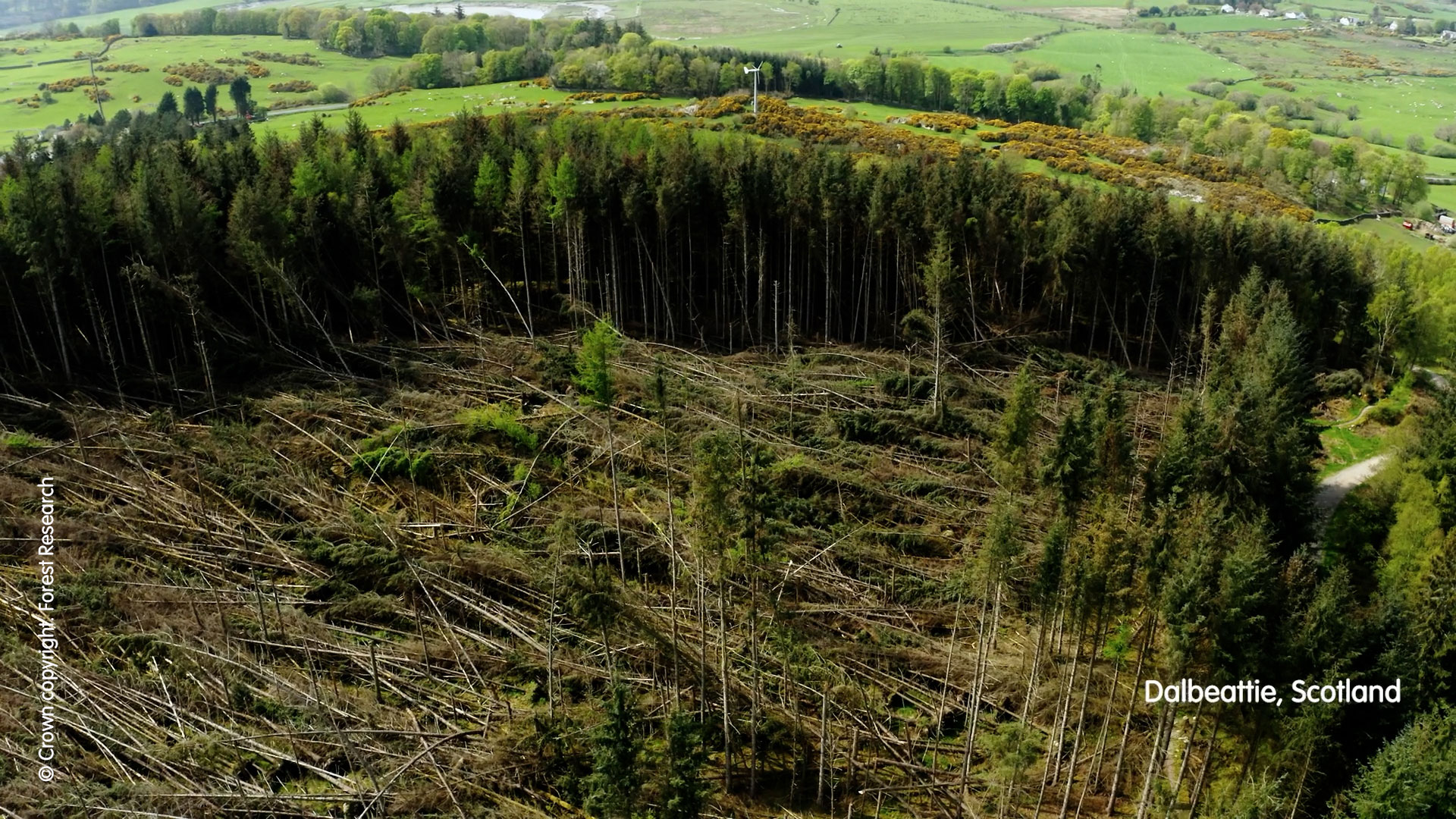
Wind damage affects trees at multiple levels. Leaf loss during the growing season slows photosynthesis and growth, while structural damage includes branch loss, stem breakage or windthrow. The type of damage depends largely on tree rooting characteristics. For example, stem breakage is commonly seen in tall, slender trees with deep roots in strong soils, while tree overturning results from poor anchorage, influenced by site properties including weaker, wet soils and shallow rooting.
Wind damage severity varies spatially: small ‘endemic’ windblow pockets occur in both managed and natural forests and while they might promote ecological succession they also increase risk to surrounding trees. ‘Catastrophic’ damage involves large-scale loss. Repeated endemic damage could ultimately lead to catastrophic losses, especially in very windy areas prone to recurrent extreme events.
What is resilience and how can it help?
Managing wind damage risk focuses on promoting resilience, which comprises four elements:
- Resistance – absorbing wind impacts while maintaining function
- Recovery – returning to original state after damage
- Adaptation – long-term changes increasing damage resistance
- Transformation – when the response to the disturbance is so dramatic it results in the creation of a new system
How can we increase the resilience of forests?
Wind-resilient management operates at various scales, aiming to sustain ecosystem services such as timber, carbon sequestration, biodiversity, slope stability and water management.
Silvicultural decisions must reflect climate, soil and management goals. Starting with careful consideration of the species make-up of a forest, it is important to bear in mind that evergreen species offer larger resistance to the wind in virtue of their larger frontal area and aerodynamic roughness. Deciduous trees have lower aerodynamic drag but higher porosity, allowing greater wind penetration.
Different species, both broadleaves and conifers, have different rooting tendencies that might make them better suited to different soils. Important soil properties to consider when choosing species for stability include soil moisture, fertility, aeration and mechanical strength. Useful and accessible information is provided in publications by Forestry Commission and Forest Research such as the Information Note “The Influence of Soils and Species on Tree Root Depth”.
When planting species mixtures, it is important to consider how different mixtures might perform, as growth patterns will influence the vulnerability of the forest to wind damage. Information about establishing suitable species mixtures can be found on the section on “Creating mixed species stands” of the UKFS Practice guide – Adapting forest and woodland management to the changing climate.
Why is thinning so important?
One of the most powerful silvicultural techniques to increase the stability and resilience of a forest is thinning. From a wind risk standpoint, the immediate effect of thinning a forest stand is that the retained trees become exposed to considerably higher wind loadings. This typically exposes the trees to higher risk, but it also promotes acclimation to the wind climate, such as increased radial growth at the base of the tree, leading to lower height/diameter ratio, and the development of larger and stronger structural root systems (when not impeded by unfavourable site conditions). Acclimation of trees to increased wind penetration after a thinning typically takes place within about 3 – 10 years depending on tree species, stand maturity and site conditions.
Thinning and tree removals are essential practices towards the development of modern silvicultural systems, such as continuous cover forestry, that are believed to be more wind stable than traditional commercial forestry practices. While early thinnings are unlikely to provide as attractive financial returns as later thinnings, eliciting wind acclimation during the early developmental stages will confer better stability later in a tree’s life. As part of the Defra-funded Centre for Forest Protection programme, Forest Research, in collaboration with Wakehurst Arboretum (run by Kew Gardens), is currently undertaking extensive experimental work to investigate the degree of wind firmness of continuous cover forestry practices.
What tools and resources are available to help prepare for storms?
Several resources are available to support decision-making for tree and forest stability. The windthrow section of the Forest Research Climate Change Hub includes UK Forestry Standard guidance on adaptation measures to reduce the risk of wind damage at various stages of forest development, from establishment through different management choices. The Climate Change Hub is the official home for practical advice and authoritative information to help land managers, foresters and woodland owners, who often have multiple management objectives, navigate the challenges of a rapidly changing climate.
ForestGALES, Forest Research’s wind risk model and decision support tool, is available in three formats: a free online tool, an affordable Windows standalone application and a free library for the R programming language. All three versions produce wind risk estimates at the stand-level, while the R package includes the latest tree-level methodology and is designed to be used in GIS workflows.
Wind damage is expected to remain a serious challenge for UK forests and woodland, but by combining recent and ongoing developments in our scientific understanding of the interaction between silviculture and wind risk, together with the adaptation potential provided by modern management approaches, we can ensure that our forests are as resilient as possible against future disturbances.
Read more: