
Workers reach breaking point as new report reveals quiet mental health crisis in forestry
An RFS survey of over 500 professionals reveals that stress is a “constant backdrop” in forestry and arboriculture.
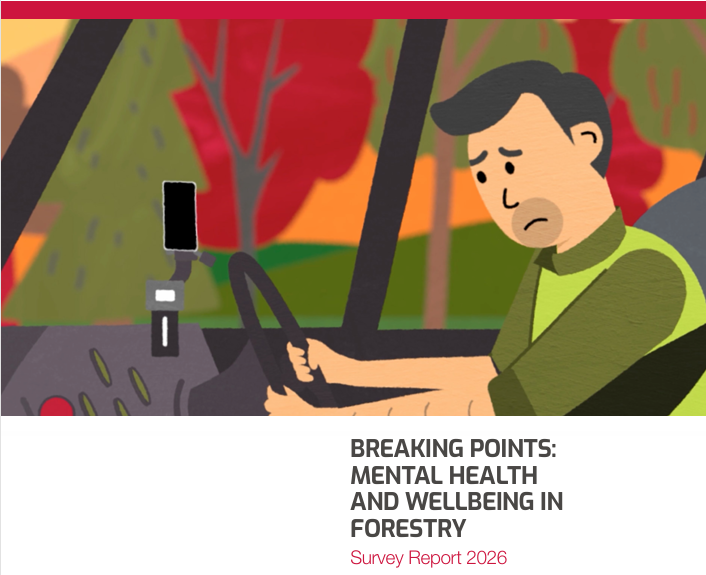
The Royal Forestry Society (RFS), working with a coalition of leading forestry organisations, today published the Breaking Points survey report, which shows the forestry and arboriculture sector is experiencing a mental health crisis.
Last year, Nick Adams, a forestry contractor and a Policy Committee Vice-Chair at the Forestry Contracting Association, suffered a stress-induced epileptic seizure after months of long hours, poor sleep and constant financial pressure.
“I’d always thought I could just push through,” he said. “But that was the moment I realised the job was going to kill me if I didn’t change something. The job is unsustainable. There is only so much someone can take before they pack it in and leave the industry or worse.”
Nick’s experience reflects a wider pattern uncovered by the Breaking Points survey, which shows stress is now a “constant backdrop” across the forestry and arboriculture workforce.
Official data show suicides have risen over the last 15 years and that men, particularly those in middle age, are at heightened risk of poor mental health. The Breaking Points survey warns that this is especially relevant to forestry, where many workers fall into this demographic and experience the compounding stressors of lone working and the transient nature of job roles.
The Forestry Commission-funded report describes forestry as a sector under “immense strain”. Financial instability, physical risk and rural isolation are heightening the risk of poor mental health among those who manage the nation’s trees and woodlands.
The Breaking Points survey gathered data from over 500 professionals in 2025, including forestry contractors, arborists, manual forestry workers and forest managers. The report notes that while the industry has improved physical safety records over the last two decades, mental health has not received the same attention.
Key Findings
The Breaking Points survey shows a workforce struggling under multiple pressures. 76% of all respondents cited financial issues as their top stressor and only 43% have regular (weekly) access to someone they trust to talk to. 44% reported explicit mental health struggles and 35% reported chronic burnout.
The report also showed that stress was felt differently across roles.
- Self-employed workers: Nearly all (94%) experience financial stress and 63% struggle with isolation and loneliness.
- Arborists: An overwhelming 92% report safety risks as a primary stressor and 56%, the highest of any role group, report emotional or mental health struggles.
- Machine Operators: 85% are stressed by safety risks, and 59% report significant isolation.
- Managers and Supervisors: Over half (57%) are stressed by policy and bureaucratic “red tape”.
The report finds that stress in the sector is often “cyclical and self-reinforcing,” where financial pressure leads to poor safety decisions and chronic burnout. A lack of spaces to talk and a cultural resistance to vulnerability means problems go unaddressed.
The findings fit into a wider discussion about mental health in rural communities. In recent years, mental health in farming has rightly gained national attention as an urgent issue. The Breaking Points survey shows that the forestry workforce faces equally severe pressures but with fewer specialised support structures in place.
It also finds that forestry workers feel undervalued and misunderstood by the public, often facing hostility for their work. The report encourages members of the public to be curious next time they see forestry work taking place locally. Rather than assuming the worst, the report urges the public to ask foresters and arborists about their work and what they are aiming to achieve. In the vast majority of cases, their work will be beneficial to people and the environment.
RFS Chief Executive and Chair of the Wellbeing in Forestry Group, Christopher Williams said: “This report outlines the scale of the challenges for those working in forestry and identifies opportunities to better support them and strengthen their resilience. I hope it provides the evidence and momentum needed to improve mental wellbeing across our sector.”
The Breaking Points report is part a larger “Wellbeing in Forestry” programme. The working group, includes the Confederation of Forest Industries (Confor), Forestry Commission, Forestry Contracting Association (FCA), Forest Industry Safety Accord (FISA), Institute of Chartered Foresters (ICF), the Royal Agricultural Benevolent Institution (RABI), the Royal Scottish Forestry Society (RSFS), the Small Woods Association and private sector consultants and contractors.
The group is urging landowners, agents and policymakers to adopt better practices regarding pay and communication. In the coming months, the group will introduce practical tools, peer support initiatives and public engagement campaigns to address the specific issues that contribute to the mental health challenges felt across the forestry and arboriculture sector.